Guangzhou Zoli Technology Co.,Ltd.

Guangzhou Zoli Technology Co.,Ltd.

Manufacturer from China
Verified Supplier
1 Years
Home / Products / Planetary Ball Mill Machine /

Planetary Ball Mill, Small Laboratory Dry And Wet Dual-purpose Planetary Ball Mill, Agate Grinding Jar

Contact Now
Guangzhou Zoli Technology Co.,Ltd.
Visit Website
City:guangzhou
Country/Region:china
Contact Person:MrsAin Qiu
Contact Now

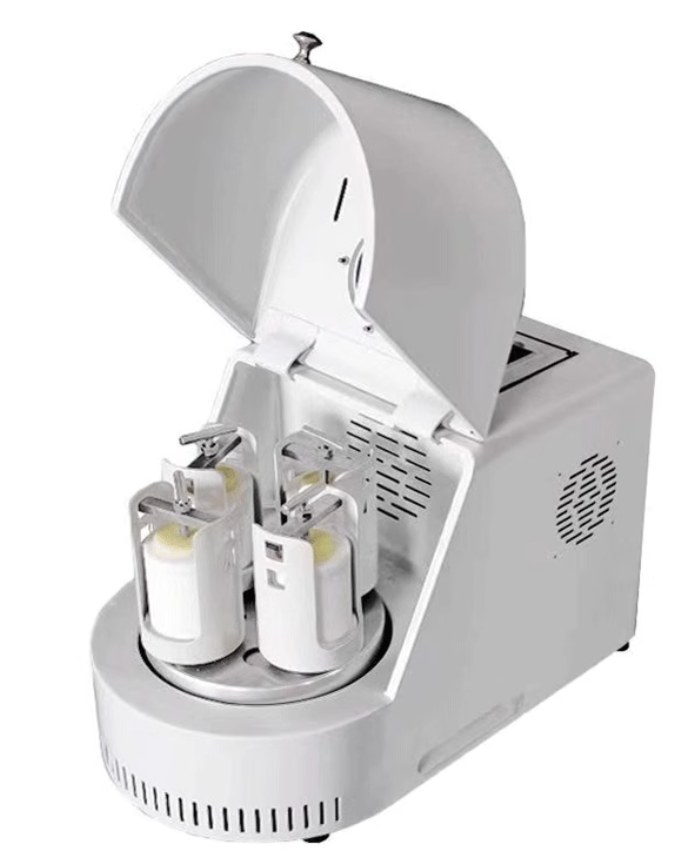
Planetary Ball Mill, Small Laboratory Dry And Wet Dual-purpose Planetary Ball Mill, Agate Grinding Jar

Ask Latest Price
Video Channel
Brand Name :ZOLI
Model Number :XQM
Certification :ISO 9001 CE
Place of Origin :China
MOQ :1set
Payment Terms :L/C,T/T,Western Union
Supply Ability :200 units per month
Delivery Time :within 15days
Packaging Details :carton+wood
Rotation Speed Ratio :2/3
Power Consumption :0.75KW
Grinding Modes :Dry/Wet
Capacity :0.4L-100L
Power :220V, 50Hz
Discharging Granularity :0.1 micron minimum
Grindingmaterial :Steel, Zirconia, Alumina
Working Principle :Planetary Motion
Dimensions :420 x 320 x 300 mm
Voltage :220V
Controltype :Digital display with timer
Numberofgrindingjars :2
Control System :Microcomputer
Type :Bench-top Planetary Ball Mill
Maximum Output Size :0.1μm
more
Contact Now

Add to Cart

Find Similar Videos
View Product Description
Integrated Product Overview

This machine is a small, versatile planetary ball mill designed for both dry and wet grinding operations in a laboratory setting. When equipped with an agate grinding jar, it becomes an essential tool for preparing ultra-fine, contamination-sensitive samples across various scientific disciplines. Its compact design and dual-purpose capability make it a cornerstone for R&D work where material purity and precise particle size reduction are paramount.

Core Components & Their Significance
  1. 1. The Agate Grinding Jar (The Key to Purity)

    Material: Agate is a natural form of Silicon Dioxide (SiO₂), closely related to quartz. It is meticulously processed and sintered to create a dense, hard, and incredibly smooth grinding medium.

    Why Agate is Chosen:
    • Extreme Hardness & Wear Resistance: With a Mohs hardness of 6.5-7, it is harder than most common materials, ensuring minimal wear during grinding. This translates to virtually no contamination from the jar itself.
    • Excellent Chemical Inertness: Agate is highly resistant to acids and solvents (except Hydrofluoric acid). It will not react with your sample, preserving its chemical integrity.
    • Smooth, Non-porous Surface: The polished surface prevents particles from embedding in the jar walls, making cleaning between samples exceptionally easy and preventing cross-contamination.
    Ideal For:

    Grinding hard, abrasive materials where even trace metal contamination would ruin the analysis. Examples include geological samples for XRD/XRF, ceramic precursors, semiconductor materials, and pharmaceutical actives.

  2. 2. Dry and Wet Dual-Purpose Capability

    This is a critical feature that dramatically expands the mill's application range.

    Dry Grinding:
    • Process: The sample is loaded into the agate jar in a dry, powdered form along with the grinding balls.
    • Advantages: Simpler setup, no need for solvents, easier post-grinding handling and drying.
    • Disadvantages: Can generate more heat due to friction. Material may have a tendency to "cake" or adhere to the jar walls.
    Best For:

    Materials that are not heat-sensitive and where the introduction of a solvent is undesirable.

    Wet Grinding:
    • Process: A liquid medium (e.g., water, ethanol, hexane, or a specialized solvent) is added to the dry powder and balls. The liquid typically fills about 1/3 of the jar's free volume.
    Advantages:
    • Prevents Caking: The liquid helps disperse the particles, reducing agglomeration and leading to a more uniform grind.
    • Cools the Sample: Acts as a coolant, mitigating heat buildup, which is crucial for heat-sensitive materials.
    • Finer Particle Size: Often allows for a finer and more stable particle size distribution by preventing re-agglomeration.
    Best For:

    Achieving sub-micron or nano-scale dispersions, grinding ductile metals, and processing temperature-sensitive samples.

  3. 3. Small Laboratory Planetary Ball Mill Mechanism

    Principle: The agate jar is secured on a rotating disk (sun wheel). It simultaneously revolves at high speed around a central axis and rotates around its own axis in the opposite direction.

    Result: This planetary motion generates powerful Coriolis forces. The agate grinding balls inside the jar are subjected to these forces, leading to a combination of high-impact impacts and frictional grinding against the jar walls, efficiently pulverizing the sample.

Technical Specifications (Typical for a Small Lab Model)
FeatureSpecification
Model TypeSmall Laboratory, Benchtop
Grinding ModesDry and Wet (Dual-Purpose)
Typical Jar Volume50 mL, 100 mL, 250 mL, 500 mL
Jar & Ball MaterialAgate (as specified; other materials like SS, ZrO₂ are also compatible)
Number of JarsTypically 2 or 4
Final Fineness< 1 µm (can be nano-scale with optimized conditions)
Speed ControlDigital, Programmable (e.g., 100 - 800 rpm)
Control SystemProgrammable for time, speed, and run/pause cycles
Typical Applications with an Agate Jar
  • Geology & Mining: Preparing pristine soil and rock samples for accurate XRF (elemental analysis) and XRD (mineralogical analysis) without metal contamination.
  • Ceramics & Glass: Grinding raw materials and precursors for advanced ceramics where iron contamination must be avoided.
  • Pharmaceutical Research: Size reduction of active pharmaceutical ingredients (APIs) for bioavailability studies.
  • Archaeology: Contamination-free grinding of ancient artifacts for compositional analysis.
  • Electronics: Preparing high-purity ceramic powders for capacitors, sensors, and other electronic components.
  • Pigments & Dyes: Fine grinding to develop consistent, high-quality colors without introducing impurities.

Planetary Ball Mill, Small Laboratory Dry And Wet Dual-purpose Planetary Ball Mill, Agate Grinding JarPlanetary Ball Mill, Small Laboratory Dry And Wet Dual-purpose Planetary Ball Mill, Agate Grinding JarPlanetary Ball Mill, Small Laboratory Dry And Wet Dual-purpose Planetary Ball Mill, Agate Grinding JarPlanetary Ball Mill, Small Laboratory Dry And Wet Dual-purpose Planetary Ball Mill, Agate Grinding JarPlanetary Ball Mill, Small Laboratory Dry And Wet Dual-purpose Planetary Ball Mill, Agate Grinding Jar

Operational Advantages Summary
  • Maximum Purity: The agate jar ensures your sample remains uncontaminated by the grinding process.
  • Unmatched Versatility: The dry and wet dual-purpose design allows you to process a vast range of materials using the optimal method.
  • High Efficiency: The planetary mechanism provides the high energy necessary for rapid nano-scale grinding.
  • Precision and Reproducibility: Programmable controls guarantee that every experiment is repeatable.
  • Compact Footprint: The small laboratory size makes it ideal for any lab bench.
Inquiry Cart 0